Whilst enabling 360° connectivity and long-range, resilient communications, the SBA’s ability to focus energy in specific directions makes SBAs useful for electronic support, electronic attack, signal monitoring, and other spectrum-dominance missions.
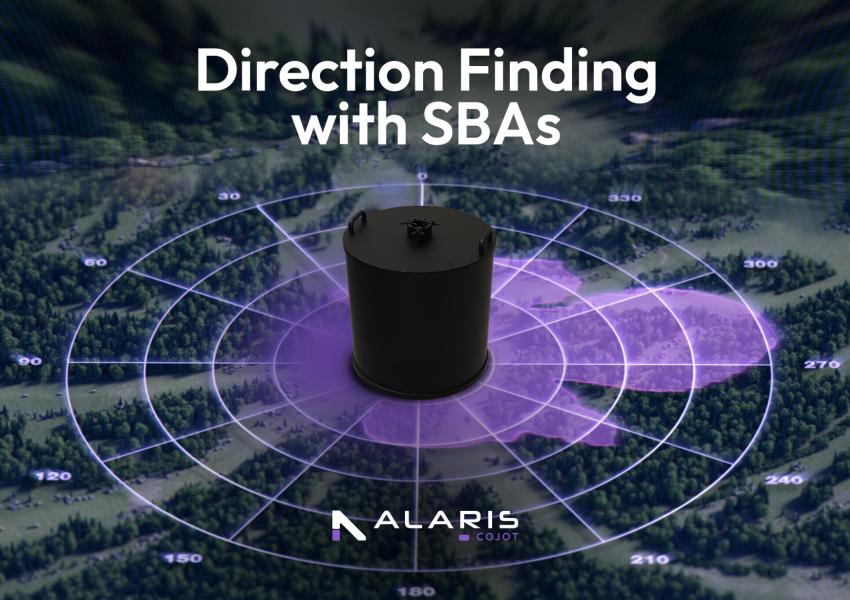
By utilising multiple sharp beams - typically 20 to 24 - SBAs allow direction of arrival (DoA) estimation through amplitude-based methods. A simple comparison of signal strength between adjacent beams already provides a fast indication of signal direction, while more advanced correlative analysis can further refine accuracy when required.
This approach allows customers to implement direction finding without complex hardware architectures, making SBAs easy to integrate into existing RF systems. The beam structure itself provides valuable directional information, supporting applications such as Counter-UAS, spectrum monitoring, and tactical communications.
Expanding Capability with the SBA1060B
The recently introduced SBA1060B extends these advantages to wideband applications, covering 1000 to 6000 MHz in a single antenna solution.
Key features include:
Up to 20 electronically steerable beams for full 360° coverage
Fast beam switching (<3 µs) for dynamic environments
High directivity with interference suppression capabilities
Modular design for straightforward system integration
With fully electronic steering and no mechanical moving parts, the SBA1060B is designed for reliable operation and easy deployment.
A Practical Approach
Alaris Cojot’s SBAs combine directional performance with scalable complexity, allowing users to start simple and expand capability as needed. The result is a solution that supports operational direction finding while keeping system integration efficient and practical.
This product range effectively gives operators multiple antenna modes in a single intelligent antenna, allowing them to optimise coverage, range, security, and spectrum efficiency in real time. This makes SBAs particularly valuable for defence, security, naval, surveillance, counter-UAS, and mission-critical communication applications where adaptability and operational effectiveness are essential.